
Every used car sold through the Japanese trade — whether it goes under the hammer or sits in a dealer's fixed-price stock — is inspected first and gets a single sheet of paper describing its condition. In Japan this sheet is the car's reputation. Buyers there bid on it without ever seeing the vehicle, sometimes hundreds of cars a day, and the whole system only works because the inspector's marks are trusted.
That sheet travels with the car. When you buy from Japan, you are not reading a seller's description — you are reading a report written by someone who had no stake in the sale. Once you know the notation, you can judge a car from nine thousand kilometres away better than most people judge one standing in front of them.
Here is the whole notation.
1. The big number in the corner: the overall grade
One figure summarises the car. It is written large, usually top right.
- S or 6 — essentially new. Under a year from first registration, delivery mileage.
- 5 — near perfect. A car that has been driven very little and looked after.
- 4.5 — excellent. Minor blemishes at most, typically under 60,000 km.
- 4 — above average. Small scratches and dents, nothing structural.
- 3.5 — the most common grade on the market. An honest used car that may want minor cosmetic work.
- 3 — noticeable damage: larger dents, scrapes, paint blemishes. Body work needed.
- 2 — corrosion holes.
- 1 — heavily modified, flood or fire damage.
- R or RA — accident repair history. RA means the damage was minor and the repair was good; an RA car can otherwise be in 4.5 condition. R covers everything heavier.
- 0, *** or blank — not inspected, sold as is.
Grades 4 and above are where we work. Below that, the maths of shipping a car nine thousand kilometres stops making sense.
2. The two letters: exterior and interior
Next to the grade sit two letters, graded separately from the number.
- A — like new. Clean, fresh, no marks worth writing down.
- B — good. Light wear, a few minor marks.
- C — average. Visible stains, wear, small damage.
- D — poor. Heavy staining, torn trim, odours.
Some auction houses extend the scale to E. The letters matter more than people expect: a car can carry a strong overall grade and a C interior, and the interior is the part you sit in every day.
3. The diagram: where the marks actually are
The centre of the sheet is a car seen from above, flattened out — bonnet, both flanks, roof, boot. Wherever the inspector found something, he writes a letter on that panel.
- A — scratch.
- E — a dimple. A dent so shallow it has its own code.
- U — dent.
- B — dent and scratch together.
- W — repair trace. The panel has been repaired or repainted before.
- P — needs repainting.
- X — damaged beyond repair, the panel should be replaced.
- XX — the panel has already been replaced.
- S — rust.
- C — corrosion, which is rust that has eaten into the metal.
- G — a chip or crack in the glass.
- Y — a tear.
- Z — a broken part.
- 歪 — distortion. Structural, and the one mark that should stop you.
4. The digit after the letter: how big
Every mark carries a size from 1 to 4.
- 1 — the size of a thumb. You would have to look for it.
- 2 — the size of a palm.
- 3 — bigger than a palm. Visible from across the car park.
- 4 — large, deep, needs proper repair.
This is where most people misread a sheet. A1 and A3 are the same letter and completely different cars. A sheet covered in A1 marks describes a car that has been parked in cities for three years. A single B3 on a rear door describes one real dent you will see every time you walk up to it.
5. The odometer line and the repair history
Two more boxes decide more than all the scratches put together.
The mileage box has small marks beside it for miles (the car was imported and reads in miles), replaced, tampered and unknown. Japan runs a national odometer record — every inspection, every service at a registered garage writes the reading into it — so a wound-back clock is usually caught and flagged here. A clean mileage box in Japan means considerably more than a clean one in most markets.
W marks and repair history are not the same thing
Separately from the diagram, 修復歴 — repair history — is marked 有 (yes) or 無 (no). This refers only to structural repair: frame, pillars, the parts that make a car safe. A car can carry several W marks, meaning individual panels were repaired, and still be 無 — no structural history. Conflating the two is the single most common mistake buyers make.
6. The inspector's own notes
At the bottom there is a free-text box, and two printed lines the inspector rings: one for the windscreen — scratch, stone chip, crack, repair mark, needs replacing — and one for the interior — scratch, soiling, burn, hole, wear, tear, rip.
This is where the inspector writes what the codes cannot: a warning lamp, an aftermarket exhaust, a missing spare key, a worn gear knob. It is short, it is blunt, and it is often the most useful part of the sheet.
7. Three sheets, one car
The best way to see the notation work is to put three sheets for the same model side by side. Here are three Toyota GR86 — the same 2.4-litre coupé, three different lives.
The first: grade S
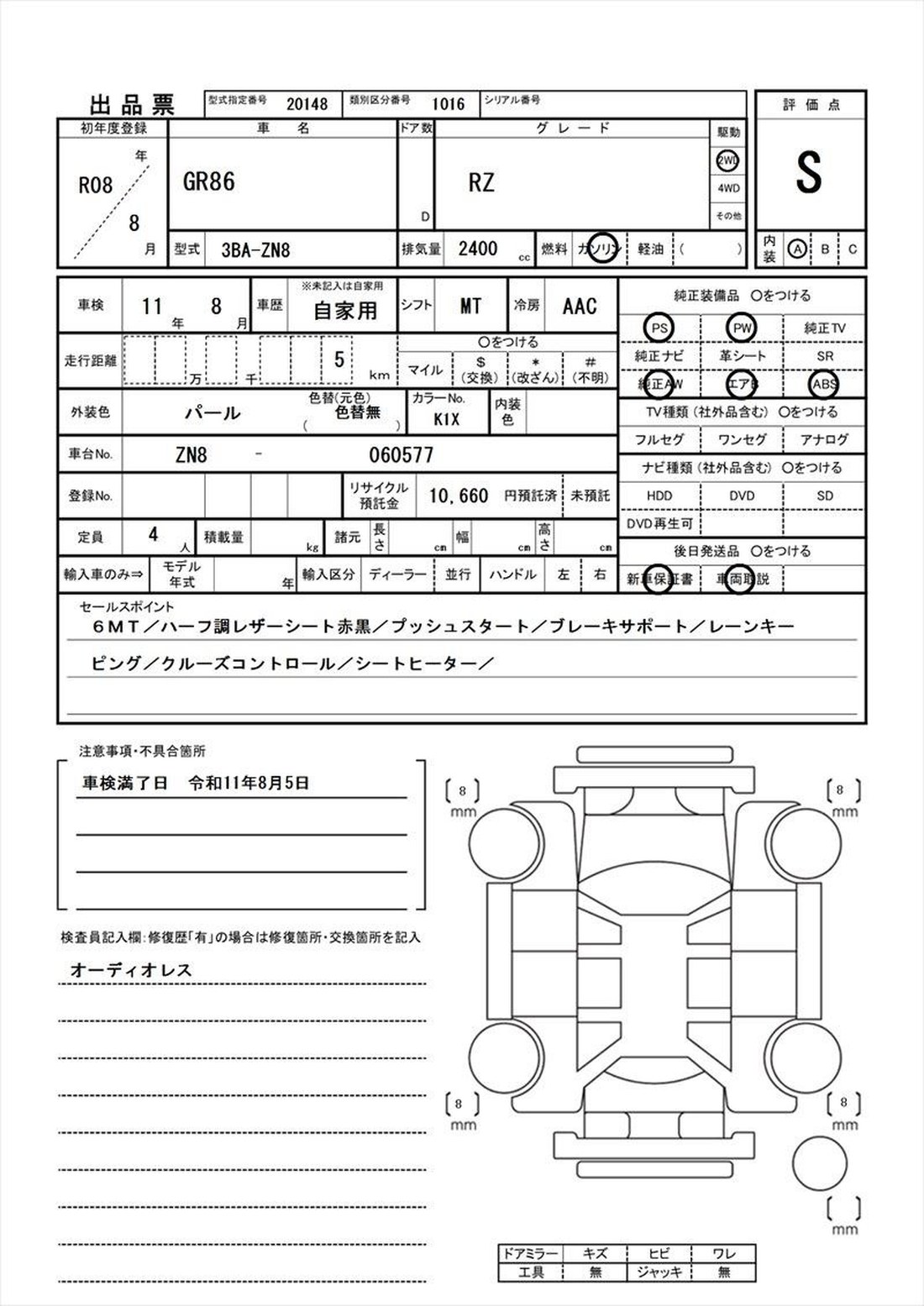
A 2026 RZ, first registered in August, 5 km on the odometer. Interior A. The diagram is empty — not a single letter anywhere on it, and the tread depth is written as 8 mm at all four corners, which is what a tyre measures before anyone drives on it. The only things in the inspector's box are that the car has no audio head unit and comes without the jack and tool kit. Half-leather seats in red and black, six-speed manual, cruise control, seat heaters, new-car warranty booklet present.
There is nothing to weigh up here: the sheet is blank because the car has not been used yet.
The second: grade 4
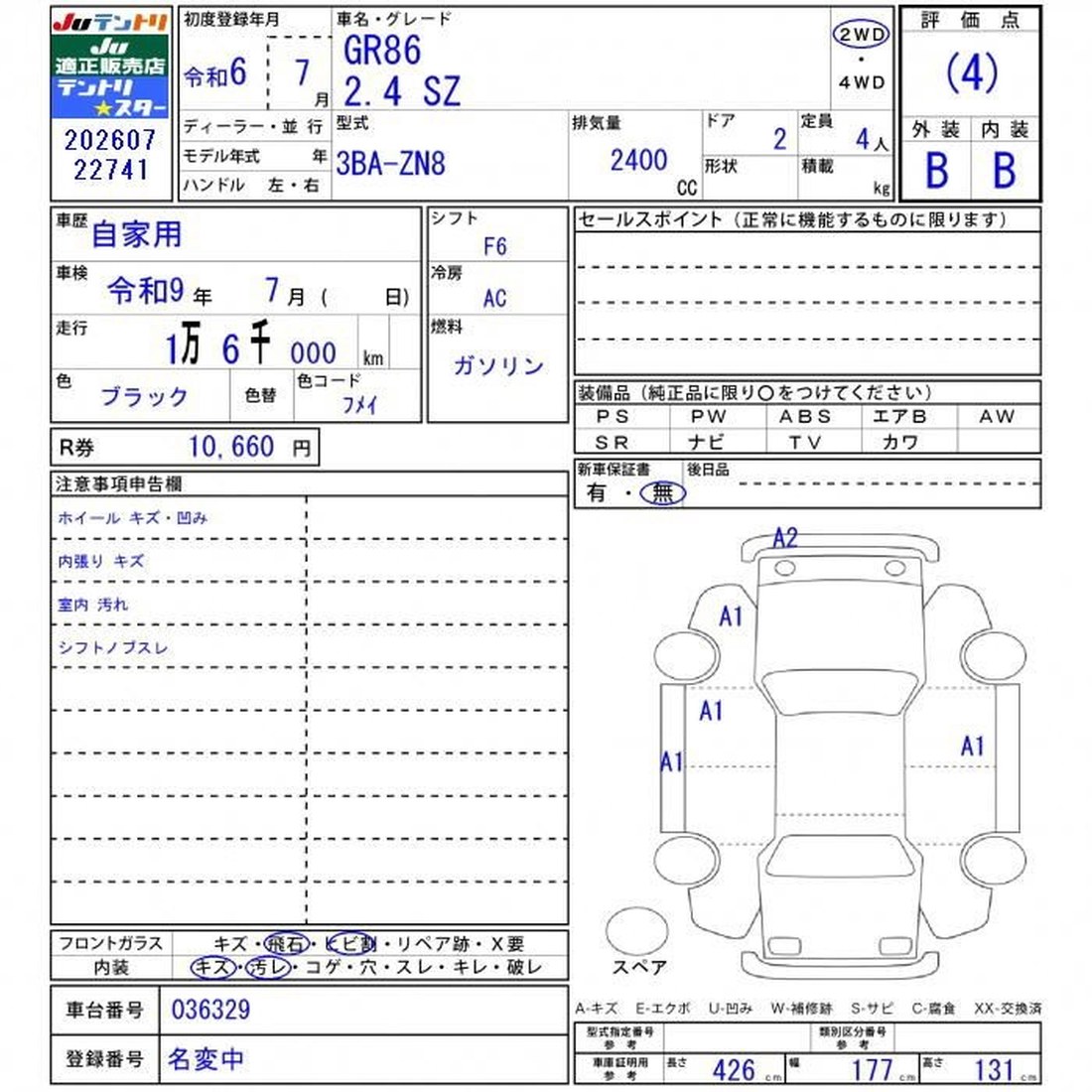
A 2024 SZ, 16,000 km, exterior B, interior B. The diagram carries five marks: A2 across the boot lid, and four A1 scratches spread along both flanks — rear wing, door and sill. The windscreen line has stone chip and crack ringed. The interior line has scratch and soiling ringed. And the declaration column adds what the codes cannot: scratches and dents on the wheels, a scratch on the door trim, and a worn gear knob. New-car warranty: none left.
Read together, that is a car that has been driven properly for two years — a chipped and cracked screen you will want to replace, kerbed wheels, a shiny gear knob. Nothing about it is hidden, and nothing about it is structural.
The third: grade R
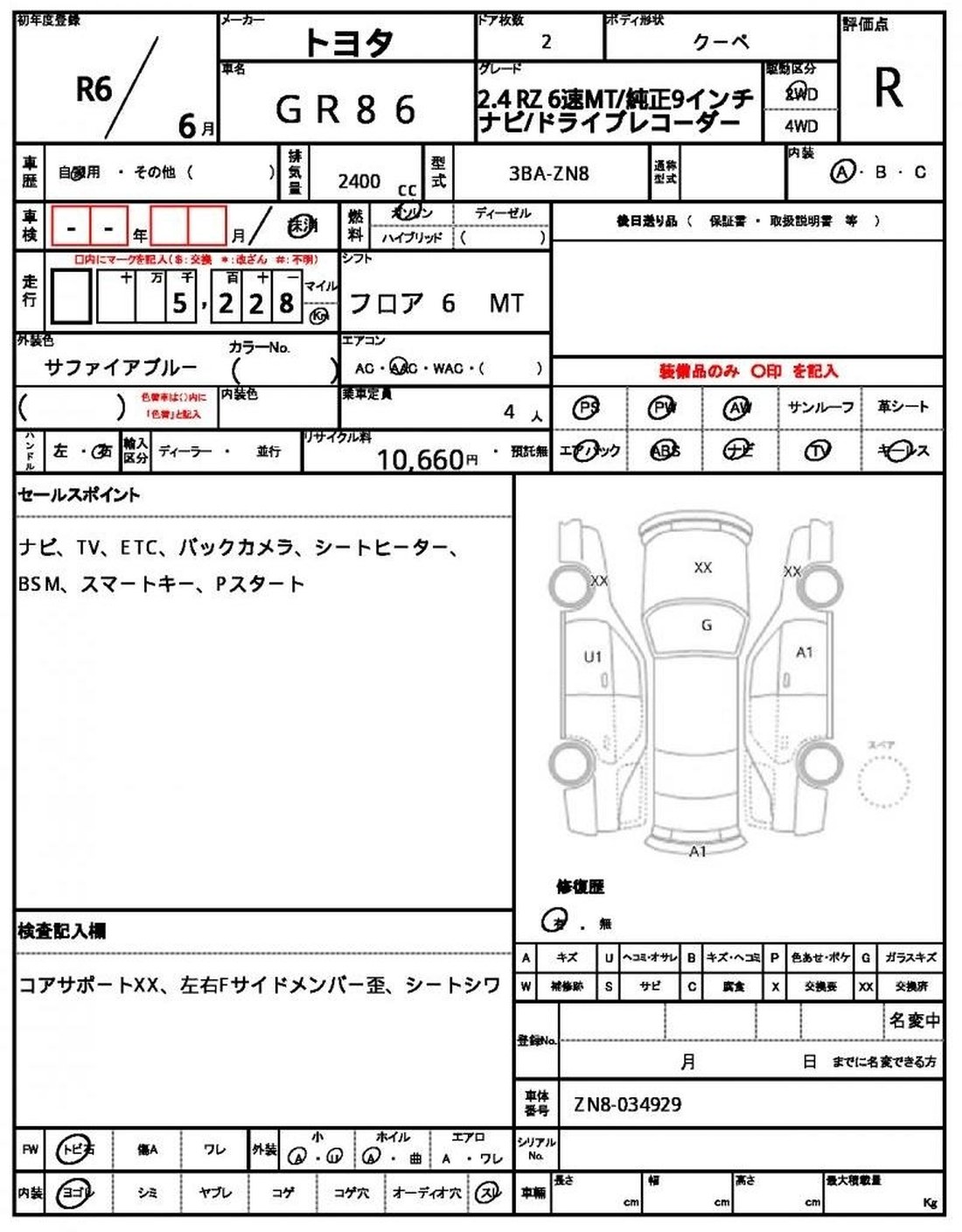
Another 2024 RZ, first registered in June. And here is the number that matters: 5,228 km. Interior A. By mileage this car is as untouched as the first one. The grade in the corner says R.
Repair history is marked 有: yes. Because it is marked yes, the inspector has to write down where — and he has, in one line: core support XX, left and right front side members 歪, creasing in the seat.
Those two entries are the whole story. The side members are the beams that run forward under the engine bay and take a frontal impact; 歪 is the distortion code from the list above, the one that should stop you — and here it is, handwritten, on both of them. The core support is the frame that carries the radiator and the front of the car, and XX means it was not repaired, it was replaced.
The diagram says the same thing in pictures: XX on the bonnet and on both front wings, G on the windscreen, then U1 on the left door, A1 on the right door and A1 on the rear bumper. Everything forward of the windscreen has been replaced.
Put the first and the third sheet next to each other. Almost the same mileage — 5 km against 5,228 — and two cars with nothing in common. The odometer told you nothing at all. The grade in the corner and two lines in the inspector's box told you everything.
You will notice the three sheets do not even look alike — different auction houses and dealer groups use different layouts. The boxes move around; the notation does not. Once you can read the letters, you can read any of them.
8. Why this matters before you pay anything
A sheet takes a minute to read and settles most of what you want to know about a car: how hard it was used, whether anyone has been inside the structure, and whether the things that are wrong with it are things you care about.
That is why we send the original sheet for every car we offer — marks and all, before anything is agreed. Not a summary of it, and not the good parts of it. The whole sheet, the way the inspector wrote it.
If you want the other line of your quote explained, the customs duty one is here: 0% duty on a car from Japan.
And if you are wondering who else stands between you and that sheet, and what each of them costs: the car is the same — the number of hands it passes through is not.