
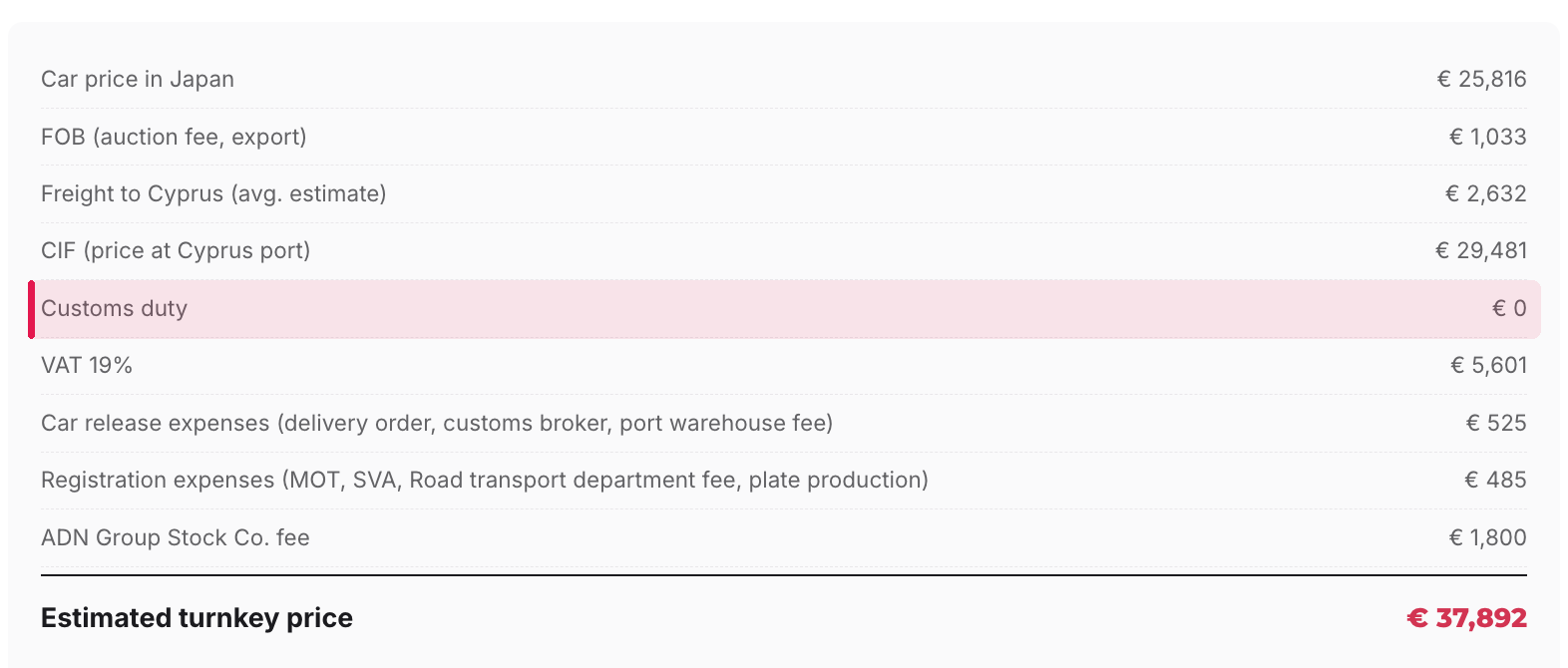
Open a Japanese-built car on our site, look at the price breakdown, and you will find a line that looks like a typo: Customs duty — €0. Open a German car from the same dealer stock and that line is back at 10%. Here is where the zero comes from, what it saves you, and why it is not automatic.
Importing a car into the European Union is supposed to cost 10% at the border. Everyone knows that figure, which is why the duty line in our calculator is the one people ask about first.
The answer is a trade agreement that quietly changed the economics of buying a Japanese car in Europe — and one that most buyers in Cyprus have never heard of.
What the EU–Japan EPA actually is
In July 2018 the European Union and Japan signed the Economic Partnership Agreement — the EPA. It came into force on 1 February 2019, and at that moment created the largest free trade area in the world: roughly a quarter of global GDP and some 600 million people under one set of rules.
The agreement removed customs duties on the overwhelming majority of goods moving in both directions. Cars were the politically difficult part, so they were not freed overnight. Japan Customs put it plainly at the time: automobiles, current customs duties 10%, duties will be eliminated in 8 years — a slice of the rate removed each year until nothing was left.
That staircase has now been walked to the bottom. A passenger car of Japanese origin enters the European Union at a duty rate of zero. Not a discount and not a special regime: the ordinary treaty rate for a car that qualifies.
What it is worth in real money
The 10% would be charged on the CIF value — the car, plus the Japan-side costs, plus the freight to Cyprus. But that is only half the effect, because VAT in Cyprus (19%) is charged on CIF plus duty. Remove the duty and you also remove the VAT that would have been calculated on top of it.
Take the car in the breakdown above. Its CIF value is €29,481, and the total comes to €37,892.
- As it stands: duty €0, VAT €5,601. Paid at the border: €5,601.
- Without the agreement: duty €2,948, VAT €6,162. Paid at the border: €9,110.
Difference: €3,508 on this one car. The same car, the same ship, the same paperwork — and a total of €41,400 instead of €37,892.
A useful rule of thumb: the agreement is worth about 11.9% of the CIF value — the 10% duty, plus the 19% VAT that duty would have dragged along with it. On a €50,000 CIF that is €5,950. On €70,000, €8,330.
On most of the cars we ship, it is the largest single line item that isn’t on your invoice.
Nobody gets it automatically
Here is the part that separates a real quote from an optimistic one.
Customs does not grant a zero rate because a car arrived on a ship from Japan. The preference applies to goods that originate in Japan, and origin has to be proved at the moment of clearance. Without valid proof the officer applies the full 10%, and the VAT recalculates upwards with it. By then the car is already at the port, and there is nothing left to negotiate.
So the question is never whether the treaty exists. It is who produces the paperwork, and whether that paperwork holds up.
Who issues the proof
Under the EPA, preferential origin is claimed in one of two ways: on a statement on origin made out by the exporter, or on the importer’s own documented knowledge of how the goods were produced. For a car crossing the world, the first route is the one that works in practice.
The statement is made out by the exporter and must carry that exporter’s reference number. For a Japanese exporter that number is the Japan Corporate Number — the 13-digit identifier assigned by Japan’s National Tax Agency. There is no separate licence to apply for and no registration scheme on the Japanese side: the number a customs officer in Cyprus checks is the same number anyone can look up in the public register.
Ours is 9230001006122. Open it, and you will see ADN GROUP Co., Ltd. at Tsubatae 663, Imizu, Toyama — the same company and the same address that appear on your invoice and on the declaration of origin travelling with your car.
We issue that declaration for every car we ship. It goes by DHL to our representative in Cyprus together with the export certificate and its certified translation, the paid bill of lading and the invoice. When the customs declaration is filed, the document that turns 10% into 0% is already in hand.
A treaty, an exporter with a checkable number, and the right piece of paper. That is the entire mechanism.
Origin means where the car was built — not where you bought it
This is the part that catches people out, and it is worth understanding before you fall in love with a particular car.
Origin is a question of manufacture, not of the showroom. Not every car sold in Japan is a Japanese-built car. Plenty of models on the Japanese market are assembled in Thailand, in the United Kingdom, in Turkey, in Mexico, in South Africa — including some of the most familiar nameplates in the country. A perfectly ordinary Japanese-brand car can turn out to be, for customs purposes, a Thai car. The EPA preference then simply does not apply to it, no matter how many years it spent in Japan or which port it sailed from.
The same logic runs in the other direction, and can work in your favour: a European brand built in Japan is Japanese for origin purposes.
None of this is visible from the model name, the number plate or the auction sheet. It comes from the build data — which is why we establish origin for each vehicle before quoting a price rather than after. When a car does not qualify, the duty goes into the calculation openly and appears in the breakdown like any other line. That is precisely why the price is assembled in front of you, item by item.
New or used — the agreement does not care
A question we get often, because it sounds like it should matter: does a used car get the same treatment as a new one? Yes. The EPA sets rates by what a product is and where it was made, not by how many kilometres it has done. A used passenger car of Japanese origin clears at the same zero rate as a new one.
What the EPA is not
Two rules get mixed up constantly, so to be clear: the five-year age limit on cars imported into Cyprus has nothing to do with this agreement. That is a Cyprus registration rule, it applies whatever the car’s origin, and no trade treaty overrides it. The EPA decides what you pay at the border; the age limit decides whether the car can be registered at all.
And one honest caveat: a zero rate exists because two parties agreed to it. Trade agreements are renegotiated, and we would not pretend to know what any of them will look like in ten years. What we can tell you is what applies to your car, on the day it clears — which is the only figure that ends up on your invoice.
What you still pay
The agreement removes one charge. It does not make importing free:
- VAT — 19% on CIF plus duty, payable in Cyprus. Unaffected by the EPA, and always will be.
- Port release — delivery order, customs broker, port warehouse.
- Registration — MOT, SVA, Road Transport Department fee, plates.
- Our fee, shown on its own line.
- Annual road tax, which depends on CO₂ and is yours to pay as the owner — it is not part of the turnkey price and we do not quote it.
All of it appears in the breakdown of every car on the site. On a car built in Japan, the duty line among them reads zero — and now you know exactly why.
Looking at a specific car?
Message us and we will take the price apart line by line — including whether that particular car qualifies for the zero rate, which we check before quoting, not after.
If you are still weighing up whether to trust a company on the other side of the world with a bank transfer, the other half of the answer is here: “How can I trust you?” — the honest answer.