
Search "import car from Japan Cyprus" and you will find several dozen companies. Their websites say the same things, their promises sound alike, and in the end they all deliver the same product: a Japanese car, registered, keys in your hand.
The difference is invisible from the outside. It is the route. One car might change hands once between a dealer's lot in Japan and your driveway. Another might pass through three companies, two invoices and a credit line before it ever reaches a ship. You will never see those hands. You will only see the price at the end, and wonder why it is what it is.
Here are the arrangements that actually exist.
1. The showroom with a partner in Japan
A dealer on Cyprus with a showroom and cars on the forecourt, and a partner in Japan who buys for him — ideally a small licensed dealer with real access to the auctions and to dealer stock, shipping straight to Cyprus.
This one is honest, and some of these partnerships have run for decades. The cost is not a trick; it is overhead. A showroom, staff, advertising, cars sitting unsold for months — all of it has to be paid for before the dealer earns anything, and the only place it can come from is the margin on the car you buy. It works. It is just expensive.
2. The showroom with a "dealer account"
Same showroom, but the Japanese side is one of the big export houses. Not many exist; they are easy to find.
The big company opens a dealer account and the Cyprus dealer bids on the online auctions himself. That part is real. What has become normal practice is the money behind it — and here the interesting thing is whose money it is. The 10–20% deposit that goes to Japan is not the dealer's. It is the deposit you paid him when you ordered the car; he simply forwards it. The remaining 80–90% is funded by the exporter, who invoices the dealer for it. The dealer settles that invoice when the car lands on Cyprus and you pay him the balance.
Look at that chain again. Your deposit goes in at the start, your balance comes in at the end, and the exporter's credit bridges the three to four months in between. The dealer has not put in a euro of his own. And nobody in this business lends money for free for a quarter of a year — the exporter does not either. The interest is inside the invoice, the invoice is inside your price, and it sits on top of the showroom's own margin from scenario one. You have financed the whole deal and paid interest for the privilege.
3. The helpers
No showroom, no stock. A person, or a small company, who knows a couple of routes, knows the big trading houses, and knows how to clear a car through customs and registration on Cyprus. Their cut is smaller than a dealer's, and that is a real advantage.
The weakness is the Japanese end, which most of them have never seen. The large trading houses sell them direct access to auctions and dealer stock. What they actually get is a dealer account for the auctions — which is real — and, for stock, a mirror: cars from the public one-price platforms, re-listed on the exporter's own site with the price adjusted and the original figure out of view. They buy at what they believe is the market. The market was somewhere below, on a system they cannot see.
Which system, and why they cannot see it, is section 6.
4. The Japanese dealer, end to end
The fourth arrangement is the shortest chain there is. A licensed dealer in Japan — a member of the auction houses and of ASNET in its own right — finds the car, buys it in its own name, ships it, files the export declaration and the declaration of origin, and has its own representative on Cyprus for customs, release and registration.
Count the links. The seller in Japan, the dealer, you. One company between the two ends, and it is the company that actually holds the access everyone else in this article is reselling. No showroom on Cyprus to pay for, no exporter above it taking a margin, no credit line bridging the ocean.
The trade-off is honest too: there is no forecourt to walk around. You choose from the sheet and the photographs, the way the trade in Japan does, and you pay for the car before it sails, not after it lands. For some buyers that matters. For everyone else, it is where the margins from the first three scenarios go back into your pocket.
This is what we are. The rest of the detail is in section 9.
5. What a mirror looks like, in yen
A real example from this week, same car, two prices.
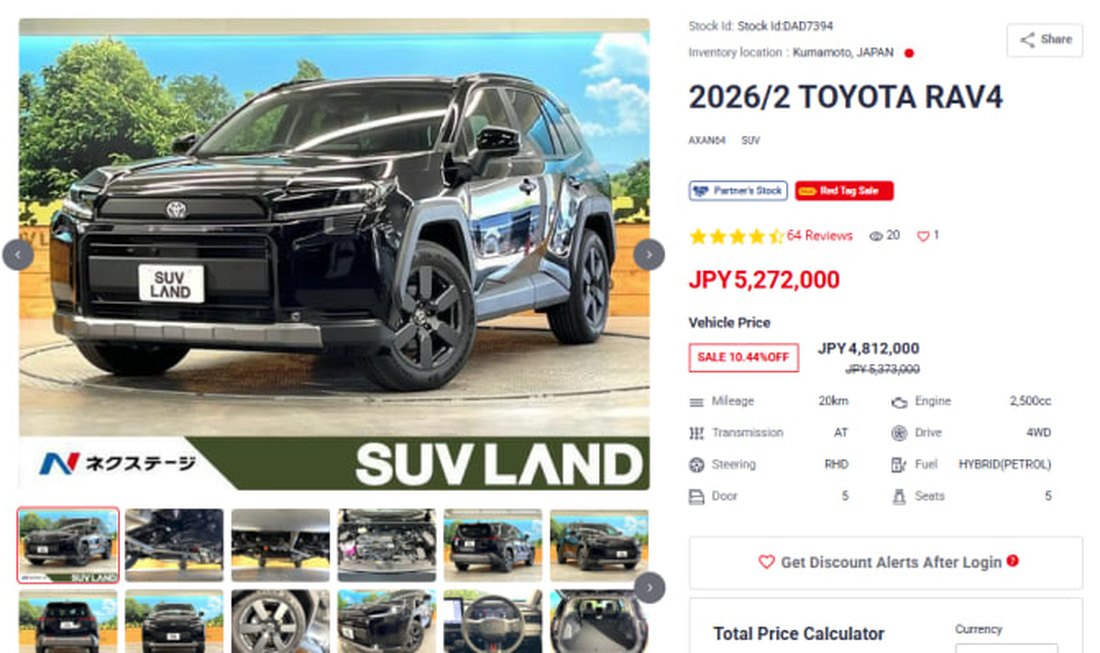
On the website of one of the large exporters: a 2026 Toyota RAV4 Adventure, offered at ¥4,812,000 — flagged 10.44% off, reduced from ¥5,373,000.
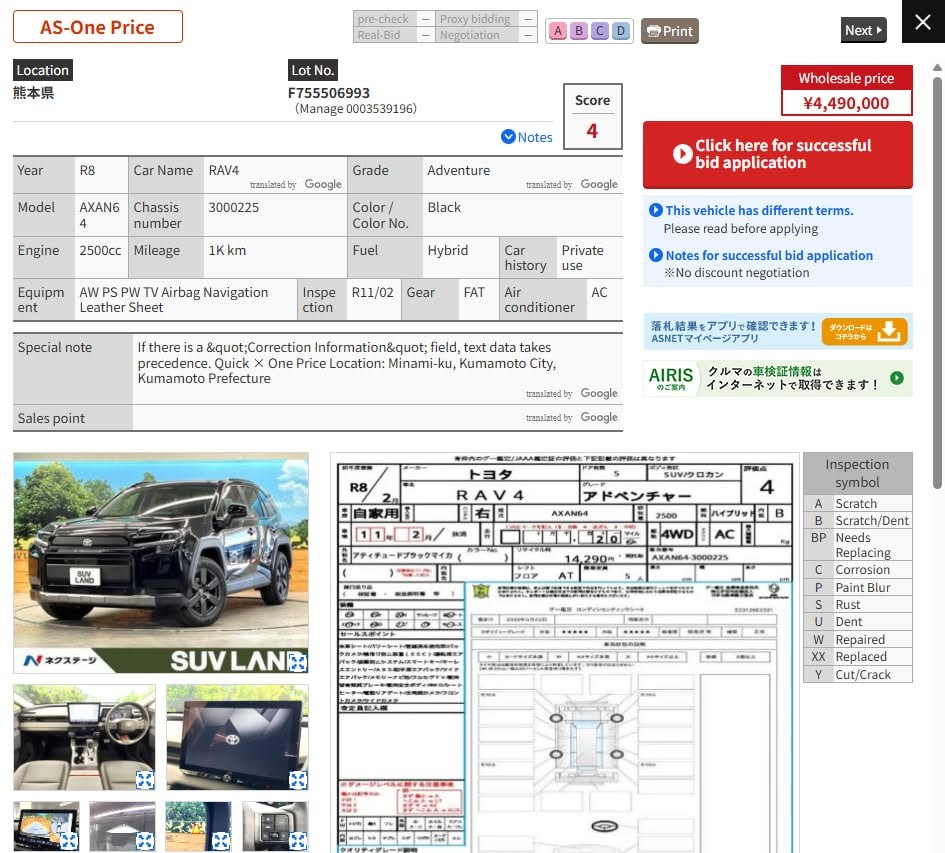
The same car, bought directly from the selling dealer on ASNET: ¥4,490,000.
So the "discounted" price is ¥322,000 above what the car costs — about 7%, roughly €1,750. And the "original" price of ¥5,373,000 is ¥883,000 above the real one. The discount is measured from a number that does not exist anywhere in Japan.
One more thing about that listing: it has no auction grade on it. Nowhere on the page. The car is a grade 4 with a B interior — and for a 2026 RAV4 with delivery mileage, we would not have offered it to a client at all. Grade 4 on a three-year-old car is a good car. Grade 4 on a car registered this year means something happened to it that did not have to. Leaving the grade off the page is not an oversight.
6. ASNET, and why you have never seen it
Japan's one-price stock is spread across several platforms. Some are public — anyone can browse them, and they can be mirrored, which is how the large exporters copy them onto their own sites.
ASNET is not one of those. It is the largest of the one-price systems, and it is closed. Only authorised Japanese dealers are admitted — a licensed company registered in Japan, vetted by ASNET itself. It publishes no lots to the public, and it offers no API. There is nothing to mirror. A Cyprus dealer cannot get in. A large exporter cannot resell access to it. Nobody outside the Japanese dealer trade, anywhere in the world, can get in.
This applies to our own site too
Even on adngroupstock.com, the cars you can browse are not ASNET cars. We are an authorised Japanese dealer with full ASNET access, and we still cannot publish its listings — the system does not allow it. What our site shows are lots from the platforms that permit public display. The ASNET cars we send you one at a time, by hand, sheet attached, because that is the only way they can be shown.
Now compare that with the auction. The auction is open to practically anyone. As described above, a large export house will open you a dealer account in five minutes and you can start bidding the same afternoon. That openness is exactly why "direct auction access" is the thing everyone sells: it is easy to give away.
Put the two facts together and you get the one that almost nobody outside Japan knows: a car that is scheduled to go through the auction next week can very often be bought today, at a fixed price, on ASNET — because the dealer who consigned it to the auction has listed it there as well. The auction crowd never sees that. They are bidding, in public, on a car that is already for sale, in private, at the price the seller actually wants.
7. Auction or dealer stock: it does not matter where you buy
There is a belief that the auction is the "real" wholesale market and everything else is a markup on it. It is not true, and the previous section is the reason.
Japan has two wholesale channels side by side. At the auction you bid, the price is discovered on the day, and you may lose the same car three times before you win one. In one-price dealer stock the car sits at a dealer with a fixed price, the same inspection sheet, the same paperwork, and no bidding.
The seller at the auction is the same dealer, and he has a reserve. He will not let the car go below the price he wants for it. And that price is not a secret — it is the one-price figure he has already posted on ASNET, which we can read this minute without bidding on anything.
Think about what an auction can do for you on that car. The floor is his reserve, which is the price you could simply pay today. From there the only direction is up. You wait for the lot, you take the risk that one or two other people want the same car, and if they do, the winner pays more than the seller was asking in the first place. That is the entire range of outcomes: pay the same, pay more, or lose and start again next week.
For a car that exists in dealer stock, the auction is not a cheaper route. It is the same route with a delay and a risk attached. Everything else follows from that:
- Faster. The car exists at a known address today. No waiting for the right lot, no losing three in a row. The booking starts weeks earlier, and at this stage weeks are the difference between one sailing and the next.
- You decide with everything in front of you. Sheet, photographs, grade — while you think, not thirty seconds before the hammer.
- The price does not move while you think. Nobody who read the sheet less carefully than you can push it up.
The auction earns its place when the car you want is rare — an unusual grade, a colour, a manual gearbox — and simply is not in anyone's stock right now. That is a real use, and we do it when a client wants exactly that car. For a mainstream model, waiting for an auction to produce what a dealer already has costs you time and, more often than not, money.
And the sheet is the same either way. A one-price car is inspected and graded exactly like an auction car. There is no second-class channel. If you want to read one yourself, we have written it up: how to read a Japanese auction sheet.
8. Four questions that place any importer in the chain
You do not need Japanese to work out where a company really sits. Ask:
"Lot number, and which venue or dealer is it at?" A real car has both. If neither can be produced, you are looking at a listing, not a car.
"Send me the original inspection sheet." Not a summary. Anyone with genuine access has it in seconds.
"What is the grade?" If it is missing from the advertisement, ask why. It is the first thing a buyer in Japan looks at, and the only reason to leave it out is that it does not help the sale.
"Whose name is on the export documents?" The company that buys in Japan, files the export declaration and appears on the bill of lading is the company with access. Everyone else in the chain is a passenger — a paid one.
9. Where we sit
We are the fourth arrangement. We buy directly on ASNET, in our own name, with our own money — and then we ask you to pay for the car straight away, once it is bought and before it leaves Japan. Not three or four months later when it lands on Cyprus.
That is the whole difference from scenario two. Nobody is carrying your car on credit across the ocean, so nobody is charging interest for it, and there is no partner above us taking a margin on the way. The money moves once: from you to us. The seller has already been paid — with our own funds, before your transfer reaches us.
Our commission is a single visible line in your quote, and you see it before you decide anything. It is the only thing we make on the transaction. The price of the car is the price of the car — which is why the numbers in section 5 are numbers we can show you.